Videos will be out soon :) :)
WGM 110702

Saturday, July 2, 2011


Friday, July 1, 2011
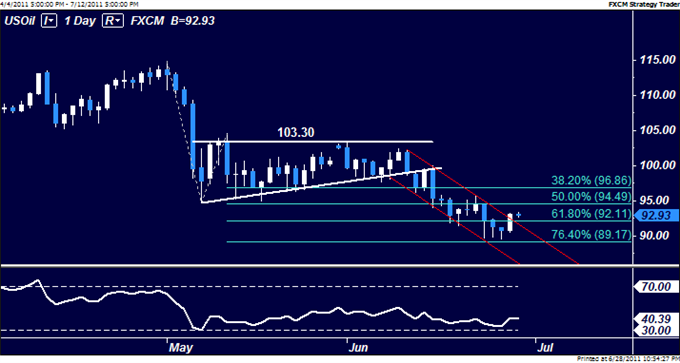
Needless to say, the outcome of the Greek parliament vote on a new austerity package – a scheme including tax increases, spending cuts and government asset sales – is in focus today. As we discussed in detail earlier in the week, last week’s successful confidence vote that allowed Prime Minister George Papandreou and his cabinet to remain in power make today’s proceedings largely ceremonial. Still, market confidence is likely to get a boost from the outcome as a degree of uncertainty about the current environment is removed, pushing crude prices higher along with the spectrum of risky assets. Key resistance has already been overcome at $92.11 – the intersection the 61.8% Fibonacci extension level and a falling channel top – exposing $94.49 from here. Official DOE weekly inventory figures are also on tap.
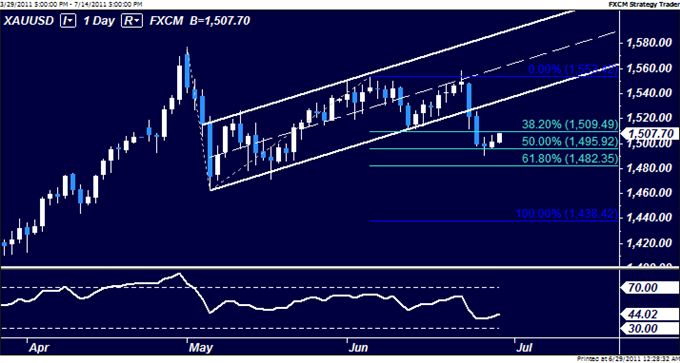
Gold Begins Recovery Amid US Dollar Weakness
Spot Gold (NY Close): 1501.40 // +3.35 // +0.22%
As we said yesterday, gold appears likely to follow risky assets higher into the Greek budget vote, with a favorable outcome that boosts overall sentiment likely to weigh on the US Dollar as the safe-haven du jour over recent weeks. Needless to say, gold is priced in terms of the greenback on global markets, so a decline in the US currency puts de-facto upward pressure on the yellow metal. A bounce from support at $1495.92 is already underway targeting initial resistance at $1509.49 and $1534.55, the 38.2% Fibonacci extension level and the underside of a previously broken rising channel, respectively.
Wednesday, June 29, 2011
IMF Executive Board Selects Christine Lagarde as Managing Director
The Executive Board of the International Monetary Fund (IMF) today selected Christine Lagarde to serve as IMF Managing Director and Madame Chairman of the Executive Board for a five-year term starting on July 5, 2011. Ms. Lagarde, who succeeds Mr. Dominique Strauss-Kahn, is the first woman named to the top IMF post since the institution’s inception in 1944.
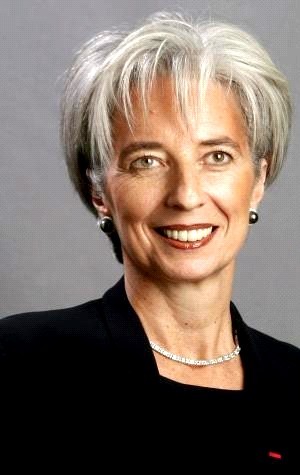
The selection of Ms. Lagarde by the 24-member Executive Board representing the IMF’s 187 member countries brings to conclusion the selection process initiated by the Executive Board on May 20, 2011 (see Press Release No. 11/191). According to the agreed procedures, the Board had agreed to meet with Mr. Agustín Carstens and Ms. Lagarde for the post. The candidates met bilaterally with Executive Directors, as well as the Executive Board, during June 20-23, 2011. In these meetings, Mr. Carstens and Ms. Lagarde had the opportunity to present all relevant information concerning their specific candidacies.
The Executive Board agreed that both were well qualified candidates and the objective was to select one by consensus. Based on the candidate profile that had been established, the Executive Board, after considering all relevant information on the candidacies, proceeded to select Ms. Lagarde by consensus. The Executive Board looks forward to Ms. Lagarde effectively leading the International Monetary Fund as its next Managing Director.
The Managing Director is the chief of the IMF’s operating staff and Chairman of the Executive Board. The chief executive is assisted by three Deputy Managing Directors in the operation of the Fund, which serves 187 member countries through about 2,700 staff from more than 140 countries.

Ms. Lagarde, 55, a national of France, has been the Minister of Finance of France since June 2007. Prior to that, she served as France’s Minister for Foreign Trade for two years. Ms. Lagarde also has had an extensive and noteworthy career as an anti-trust and labor lawyer, serving as a partner with the international law firm of Baker & McKenzie, where the partnership elected her as chairman in October 1999. She held the top post at the firm until June 2005 when she was named to her initial ministerial post in France. Ms. Lagarde has degrees from Institute of Political Studies (IEP) and from the Law School of Paris X University, where she also lectured prior to joining Baker & McKenzie in 1981.
Tuesday, June 28, 2011


Friday, June 24, 2011
New Breed of investors
The report, Anticipating a New Age in Wealth Management, includes findings from PwC’s 2011 Global Private Banking and Wealth Management Survey and shows that new competitors are challenging the dominance of established firms.
It also reveals that the impact of new regulations and more demanding client expectations are forcing private banks and wealth managers to change their client service infrastructures and the way they operate. Those who can master change will be in a position to win increased market share and lead the industry, says PwC.
Regulation has become the not so invisible hand, increasing the cost of operations while greater operational efficiency and effectiveness are required, not just to compete but to survive in the changing market place.
The report says that standing still is no longer an option and institutions must now quickly adapt or face being left behind.
New IT Solution for Banks
Smart phones and tablet devices now outnumber personal computers
At the start of 2011, the number of smart phones and tablet devices sold outstripped the number of desktop and portable personal computers. Sales of smart phones and tablets are expected to more than double by 2013. This trend places entirely new demands on how to deliver internet-based services for Norwegian consumers, and many of the solutions currently in use will have to be redesigned. This also affects traditional internet banking. A group of technology specialists at the Norwegian IT company EDB ErgoGroup has been working for some time on developing the next generation of internet banking for mobile phones. The new solution, known as Mobilbank 2, has been developed to anticipate the way that that EDB ErgoGroup expects customers to use their handheld devices looking 2-3 years ahead. The company's work anticipates the rapid spread of handheld devices. "Development work in this area is no longer driven by traditional internet banking. We now think of mobile banking first rather than the other way round", explains Ann Merethe Lysø Sommerseth.

The new solution uses graphic elements and visualisation to give banking customers an entirely new experience of mobile banking. EDB ErgoGroup has chosen to turn its back on the most widespread approach to development in this area over recent years, which has involved adapting "native apps" for handheld devices. It has instead developed Mobilbank 2 as a web application based on web technology using HTML5. This makes it possible to develop a single solution for all types of mobile phone. It has also made it possible to develop an entirely new user interface.

"We think that future trends will increasingly favour web applications. Using web applications means that the entire value chain, from customer and supplier through to developer, no longer needs to deal with a range of different applications and adaptations depending on which type of telephone and operating system is used. With web applications, the lead time from the start of development to delivery of a new product is much shorter, and the entire development process is more cost effective", explains Ann Merethe Lysø Sommerseth.
"When touch phones such as the iPhone and Android came onto the market, they changed the way we use our mobile phones. This means that banks also need to respond to the new ways these devices are used. We have paid a lot of attention to the user experience in our development work", says Ann Merethe Lysø Sommerseth. She goes on to explain that EDB ErgoGroup has now developed a solution that is at the leading edge in terms of interactive design. This technology has so far typically been used for entertainment applications, but it is also perfect for banking services.
Wednesday, June 22, 2011
Singapore set to become top private banking center
Hi guys, I have recently been rejected from the double degree programme, despite obtaining straight As for my first year in the University.
However, I will use all my strength and concentrate into banking from now onwards.
Hence, I will be reading a lot of articles to keep track of where banking is heading both in Singapore and globally so that I will be able to perform in future interviews as well as in my work next time.
So I will kick start with this short article below.
Enjoy
However, I will use all my strength and concentrate into banking from now onwards.
Hence, I will be reading a lot of articles to keep track of where banking is heading both in Singapore and globally so that I will be able to perform in future interviews as well as in my work next time.
So I will kick start with this short article below.
Enjoy
SINGAPORE will become the world's top wealth management centre by 2013, thanks to growth in emerging markets, and the decline of Switzerland and London in the wake of tougher regulations.
The findings came from a PricewaterhouseCoopers (PwC) report out yesterday that pointed to the changing balance of power in financial markets.
It said Singapore will leapfrog both European centres in the next two years, with Hong Kong in third spot behind Switzerland and ahead of London.
The findings in PwC's Global Private Banking and Wealth Management report were based on a survey of wealth managers and private bankers between December last year and April. The questionnaires were completed by 275 institutions in 67 countries - 62 per cent from Europe, 24 per cent from the Americas and 14 per cent from Asia-Pacific.
'For many years, we have asked respondents to indicate which financial centres they viewed as the main wealth management and private banking hubs,' PwC said. 'The historical answer was Switzerland, London and New York. This is now changing. This year, we asked our ranking question again, but we also explored the impact of increased regulation.
'In response to increased regulatory pressures, our respondents see Switzerland, London and, to a lesser extent, New York all being challenged by the rise of Singapore and Hong Kong in the coming two years.'
Subscribe to:
Posts (Atom)