Wednesday, November 18, 2009

Low Interest rates

As we can all see, the U.S banks interest rate are still at an all time low because of the following key reason


It is needed to help boost the number of jobs due to the recent 10.2% of unemployment


So how does a low interest rate actually helps to boost job? The typical answer to this question is that with a lower interest rate, small businesses can borrow more in this adverse financial economy and thus they have the money to expand their operations and eventually hire more people.


Contrary to popular belief, that does not seem to be the case at all. Ever since March 2009, the Fed has already forced the interest rates down all the way to a record 0%. But what actually happens to the unemployment rate in the United States? It is climbing higher and higher day by day, month by month to the 10.2% now.


So the perplexing question here is, does low interest rates effectively aid in the creation of jobs?


Personally, I'm pretty ambivalent about it. For one, I feel that the small businesses can no doubt borrow more since the odds are not against them. However, the small businesses are not helping to assuage the problem of unemployment at all. The big businesses on the other hand are cutting more jobs, even giant corporate companies are no exceptions.


With that in mind, who is actually taking in people? The answer is no one. The healthcare industry has already reached a saturated level and the education sector has all the people they need, the corporate industries are slashing jobs. So the net effect is higher unemployment.


The plausible solution here is for the government to step in when it comes to job creations. By giving the small businesses the choice to choose whether they want to hire is not feasible at all. Any businesses in the right mind will not risk hiring more people when they themselves are skeptical about the outlook of their businesses. If I were them, I will borrow as much as I can due to the low interest rates but I will wait till the economy recovers completely before I start to hire. Even though it might be an arudous journey ahead to work on low manpower, I believe I will pull through!


Credits -marketwatch, -biojobblog

Tuesday, November 17, 2009

Weak Dollars

For the generations of college kids who learned the ABCs of global economics from Paul Samuelson, a weak dollar is supposed to tip the balance of trade in favor of the nation's exporters. So why is the trade deficit exploding?

Definition of Trade Deficit : Imports exceed Exports


When your currency is weak, people will buy goods from your country especially if their currencies are stronger than yours. This is because this will permit them to ship a larger amount of goods at a lower price that before. Exporters in the country should have a time of their life during this period where the U.S dollar is at an all time low.


"While the weak dollar gives Wall Street every reason to tout the stocks of individual exporters, the flood of petrodollars leaving the country continues to wash the foundation out from under the rest of the overall economy."


"A close look at the September trade data shows most of that widening gap -- $20.5 billion -- stems from petroleum imports."


Even though the United States has been heavily involved in the exports industry, much of their efforts to earn a huge profit has been oblierated by the evil oil industry. It is imperative that they continue to import oil, first because they do not have much themselves and secondly, they function on oil more than anything else. Because of the heavy imports of oil, the profits made from exports are offsetted and trade deficit starts to explode as a corollary.


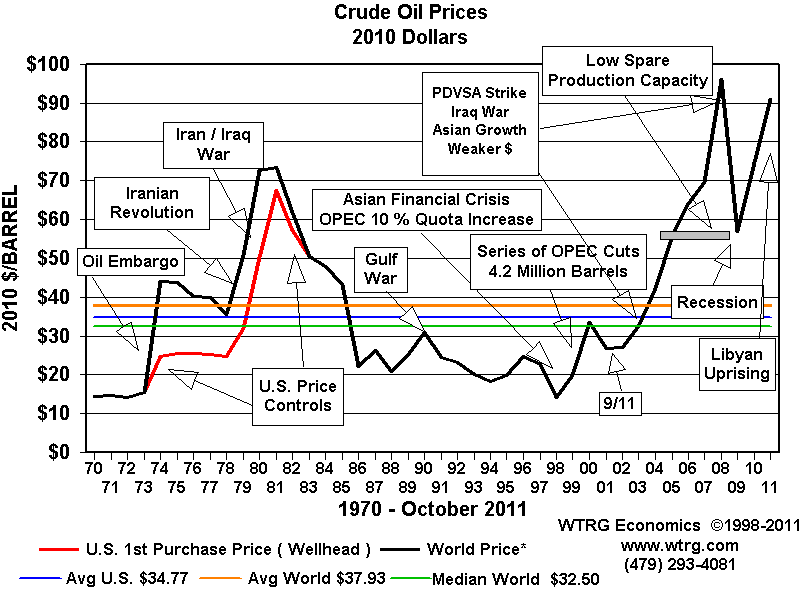
This problem is further exacerbated when the oil prices hike whenever the U.S dollars dive. It just pulls the two extremes further apart each time it happens. You get lower profits when your dollar weakens and thus you have to pay more dollars for the same volume of oil now.


So isn't it flagrant now why the trade deficits are exploding now?

Credits -marketwatch, -investorwords, -wtrg

Monday, November 16, 2009

Vincent von Gogh

The business of art is the art of business.


I wouldn’t want other people to make a decision for me.


Are you hard-selling me this product?


This is a gallery; can you give me some space?


These are often the remarks made by customers who are actually put off by the staff in an art gallery.


Some of the staffs at a gallery have taken the hard-selling approach by questioning the rationale of the existence of the customers in the gallery. They have the propensity to sell these pieces of art like how they would art a supermarket. It seems a bit insulting and taunting to question those that are there for the exhibition because everyone is there to appreciate the art.


It is really intricate and ambiguous when it comes to the purchase of art as far as I am concern. Even if I went forward to the gallery with the intention to purchase, I might not settle for a purchase if I am not really impressed with the art or the salesperson.


In the world of art, it is really about the whole package, not just the art. It includes the ambience, the people, the surroundings, the sales team and the presentation. You really have to sniff these interested buyers out amidst the sea of viewers.


The precision of timing is of paramount importance as well. You should not go in too early or too late, rather, you should go in just at the right timing where they are ruminating.


Then again, when you move in, you should listen to understand, not question their desire for it or telling them about your opinions. I suppose they just need a pair of listening ears and further reinforcements when it comes to the purchase of art.


It is not a fad or an iPod product, which people purchase to keep up with the trend. To me, it is something personal, something that is esoteric to you, relatable to you in your own ways. The role of the staff is to listen and then understand why this piece of art is so personal and importance to the potential buyer.


Once you understand that, I surmise that the potential buyer will open up and tell you his or her story. That is when you can creep in and sell the piece of art surreptitiously without him knowing that it is a business deal at all.

Credits -photo.eos, -artrenewal.org, -southwindsgames, -samcooks

Sunday, November 15, 2009

Home Sales Next Year

"By putting cash in the hands of financially healthy home buyers, the credit will continue to help draw down inventory and stabilize home prices to encourage a strong and sustainable housing recovery," said NAR President Charles McMillan in a news release.


I think this is extremely promising and I am actually believing that this will eventually work out. That is the sustainability of the sales of the homes even after the tax credit ends in Mid June 2010 which is great news! This is mainly because people buy because of the discounts they get and eventually the number of foreclosures is offsetted by the number of new purchases. With a lower number of houses left dwindling around the corner, the Fed will make more money.


However, my only concern is that the people who are offering the $8000 and $6500 tax credits respectively might be suffering big time, imagine the number of sales multiplied by the amount of money per credit. It is a gargantuan sum and how are they going to recover that sum?


Then again, if the home prices will be sustainable because of this program, it is certainly worth it because the money that can be earned from each home will definitely be more than $8000 in the long run :) Just look at the utilities bill of each household, the maintainence fee, the service fees like rubbish collections and the demands of a new household in that area.


Like I said before, houses play a pivotal role in the industry because it requires the help of so many other industries to function properly. Examples of such are the bricks industry, bank industry, furnitures industrsy, oil industry, lighting industry, gardening industry, tax industry, consumer goods industry, luxurious goods industry and etc. So much money can actually be made from an occupied home and so much money can also be lost from an unoccupied home. Thus, if the tax credit can relieve the number of foreclosures, it is definitely a worthy and safe bet.
 
 
Credits -marketwatch, -ourcountryspresident, -yourroadmaptohome, -bendoregonrealestate

Saturday, November 14, 2009

ANTM Cycle 13 Episode 11


Erin


Jennifer


Nicole


Laura

Credits -livejournal

Friday, November 13, 2009

A Christmas Carol

Watch out for Jim Carrey's latest movie, a Christmas Carol, definitely a fine christmas movie for every single kids out there. But that's if the parents are free enough to bring their kids to the theatres. You know people claim that they are so busy, even on Christmas? No finger-pointing please :)


Jim Carrey provides the voice and image of the miser Ebenezer Scrooge -- at every age -- as well as the ghosts of Christmas Past, Present and Yet to Come.


“A CHRISTMAS CAROL” OPENS IN SINGAPORE CINEMAS 19 November 2009!

Credits -open-bks

Cash For Clunkers

Remember the infamous $4,500 car credits provided to car buyers, that traded in their less-fuel efficient cars, by the United States government this year?


Results: A total of 690,000 cars were sold under the program but only 125,000 of those were vehicles that would not have been sold anyway.


In layman terms, even without the cash-for-clunkers, 82% of the cars sold will still be able to sell.


Okay, point noted but what is the appalling point here? Evidently, the point is that the dismal policy has wasted a total of


$4,500 multiplied by (690000-125000) which comes up to a gargantuan sum of $2.54 billion.


Hasn't it ever come across their mind that they should have stopped this program long ago? Now that it has bled $2.54 billion, the damage is already irreversible.


But the worst part is, they are still not the least conscious of their unconscionable mistake. Instead of stopping the program immediately, they were even ruminating about the continuation of the program since it is so well-received and that many cars are sold.


A while back on the 30 October 2009, the whitehouse released a blog post saying that Edmunds.com is deframing them and that the calculation of the number of cars that would have been sold even without the help of the program is inaccurate based on implausible assumptions, basically a mere postulation.


From my point of view, the government is simply saying that people are buying the cars because they are drawn in by the hyped-up program and that they went on ahead to purchase cars even when they realised that they did not qualify for the rebate. Honestly speaking, how can you attribute that to the rising sales of cars? That is pure bullocks I will say.


Let's say you are buying the car because of the cash-for-clunker program, and that you realise that you do not qualify for it, naturally you will go back home. Conversely, if I have decided to go ahead with the purchase even though I realise that I do not qualify for it, it is because I have already set my mind on purchasing a car regardless of any incentives I am offered. The program is mainly something that I might be able to exploit on but it is not a compulsory pre-requisite to my purchase, hence I do not really care if I qualify for it. The point is, I want to buy a car.


In this case, the government is trying to take credit for that conscious purchase of the consumers to reduce the damage and criticisms casted upon the White House. They are obviously trying to navigate their way out of this shit by taking credits for the rising sales.


They have made a mistake, so they should simply hold their hands up and apologise rather than making claims which is so baseless.


The aim of the program was to kick-start the sales and to boost the production and manufacturing of cars. However, they seem to have grown to be overly-reliant on it to boost sales now and that they are getting addicted to this sticky problem.


For now, I surmise that the industry is more than stable enough to move on independently already. By providing more help at this stage is synonymous to breeding an insidious virus within the industry per se. Till then, it will have to take a tour de force to get the industry out of its spiraling problems.

Credits -cnn, -maniacworld